
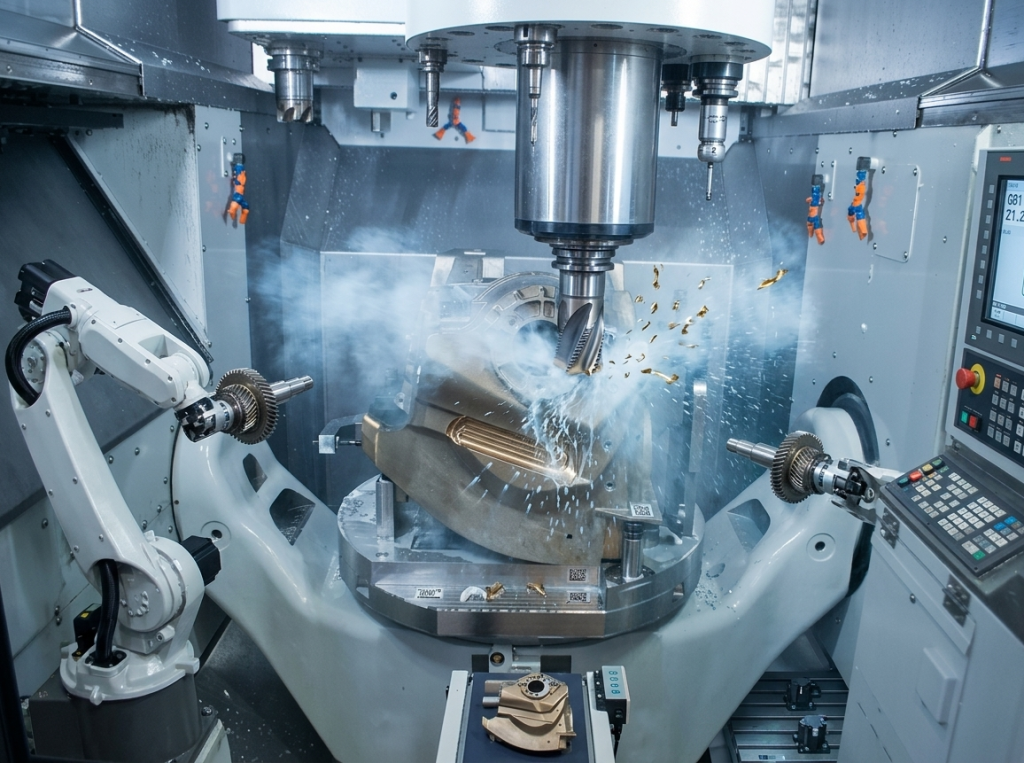
At V&S Engineering, we provide high-precision 4 axis machining services for customers who need more than basic 3-axis milling, but don’t want unnecessary complexity, cost, or risk. From prototypes to production runs, we focus on machining parts that meet specifications the first time and continue meeting them run after run.
Every time a part is removed from a fixture and re-clamped, an error is introduced. It might be small—but across tight tolerances, small errors become big problems.
4-axis machining solves this by:
For parts where true position, concentricity, or angular alignment matters, 4-axis machining dramatically reduces risk.

4-axis CNC machining expands on traditional 3-axis milling (X, Y, Z) by adding a rotary axis, commonly referred to as the A-axis. This axis allows the workpiece to rotate around a fixed axis, giving the cutting tool access to multiple sides of the part without manual repositioning.
In real manufacturing terms, this means:
4-axis machining is especially valuable when part features are located around a diameter, across multiple faces, or require precise indexing at specific angles.
Every time a part is removed from a fixture and re-clamped, an error is introduced. It might be small—but across tight tolerances, small errors become big problems.
4-axis machining solves this by:
For parts where true position, concentricity, or angular alignment matters, 4-axis machining dramatically reduces risk.
4-axis machining is often the best solution when 3-axis setups become inefficient or unreliable—but full 5-axis motion is unnecessary.
Common use cases include:
If your team is currently using multiple 3-axis setups to achieve the geometry, 4-axis machining often reduces cost, lead time, and scrap.
While 3-axis machining is excellent for many parts, it has limitations when features span multiple faces.
3-Axis CNC Machining:
4-Axis CNC Machining:
In many cases, 4-axis machining delivers a measurable improvement in precision without increasing part cost.
5-axis machining allows simultaneous movement across multiple axes and is ideal for highly complex contours. However, it is not always the most efficient or stable option.
4-Axis CNC machining is often preferred when:
At V&S Engineering, we recommend the machining method that best fits your part—not the most complex one.
Our 4-axis machining services are built around process discipline, fixture stability, and dimensional control.
Capabilities include:
Each project begins with a detailed review of the print and model to determine the most stable and efficient machining strategy.
Different materials behave very differently under rotary machining conditions. Our team accounts for this during programming, tooling selection, and inspection planning.
Aluminum
Stainless steel
Carbon steel
Titanium
Inconel®
Additional specialty and exotic alloys
Feeds, speeds, toolpaths, and inspection checkpoints are adjusted based on material behavior—not generalized assumptions.
Aerospace and defense components demand more than just dimensional accuracy—they require process control and repeatability.
Our approach includes:
This ensures that parts remain consistent across batches and production runs.
Precision machining is meaningless without verification.
Our inspection process supports:
This approach minimizes scrap, rework, and downstream issues for our customers.
Our 4-axis CNC machining services support customers across multiple industries, including:
Whether you need a one-off prototype or repeat production, our process remains consistent.
Customers choose V&S Engineering because we provide:
We focus on long-term manufacturing partnerships, not just individual jobs.